Question 1: The "Morning Mystery"
Do you wake up feeling relatively okay, but your neck feels like a "stiff board" by 2 PM?


Singapore’s specialist for chronic trigger point resolution. We resolve the microscopic "Energy Crisis" locked inside your muscles, the functional failure that standard massages and even MRIs miss.

.webp)
The Science
The Science
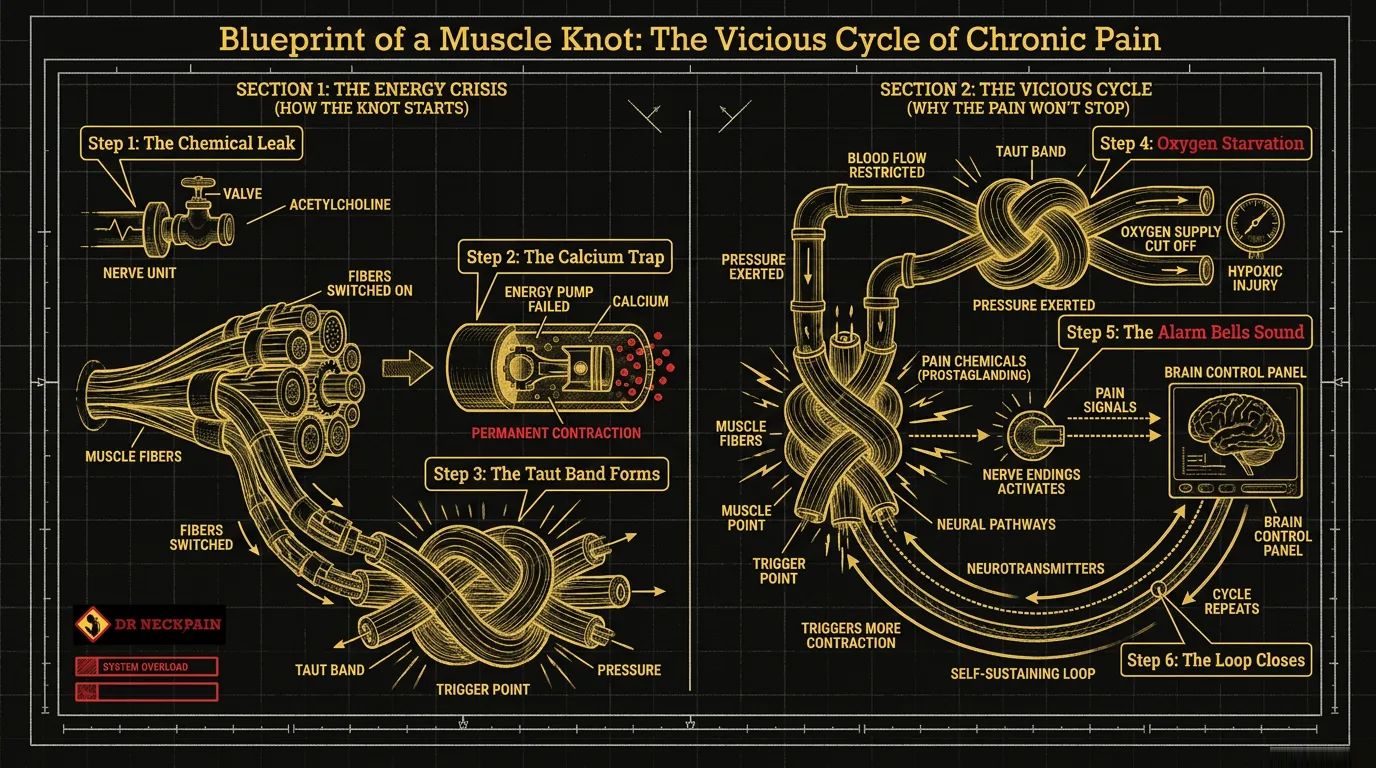
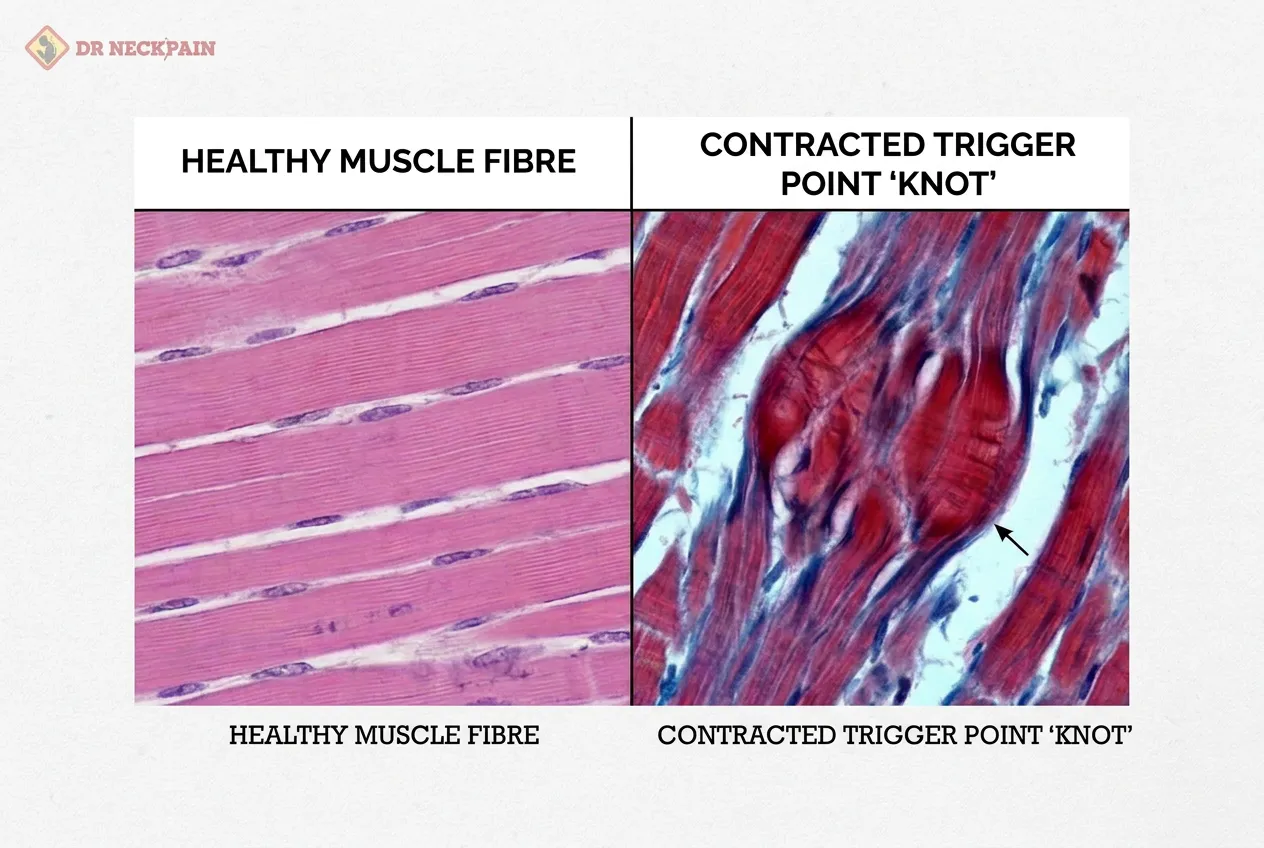
Prolonged static activity, like sitting at a desk, creates sustained micro-tension. This causes a lack of oxygen (hypoxia) in the muscle tissue, leading to a failure of the "calcium pumps" that allow muscle fibres to relax. Without energy (ATP) to reset these pumps, the muscle remains in a state of permanent contraction.
THE PROBLEM
Standard hospital tests, such as MRIs and X-rays, are designed to detect structural "breaks" like fractures or slipped discs. They cannot see the "Energy Crisis" occurring at the microscopic level of your muscle fibres.
If you have been told your scans are "clear," but you still feel like your neck is wrapped in a tight corset, you are likely suffering from Active Trigger Points.
STAGE 1
"Heavy Head" Syndrome
Feeling like your head is a bowling ball your neck can no longer support after a day at the office.
The Air-Con Flare-up
Tightness and "shivers" that feel significantly worse in cold, air-conditioned meeting rooms.
The "Ram's Horn" Headache
Pain that starts at the base of your skull and wraps around the side of your head to your temples.
The Shoulder "Rock"
A specific spot under your shoulder blade that feels like a stone and never goes away, no matter how much you stretch.
STAGE 2
The "local twitch response" is a diagnostic landmark of Myofascial Pain Syndrome. Before booking a professional assessment, perform these three clinical checks to see if your pain is Myofascial:
Find the "Rock": Locate a knot in your neck or shoulder that feels particularly hard.
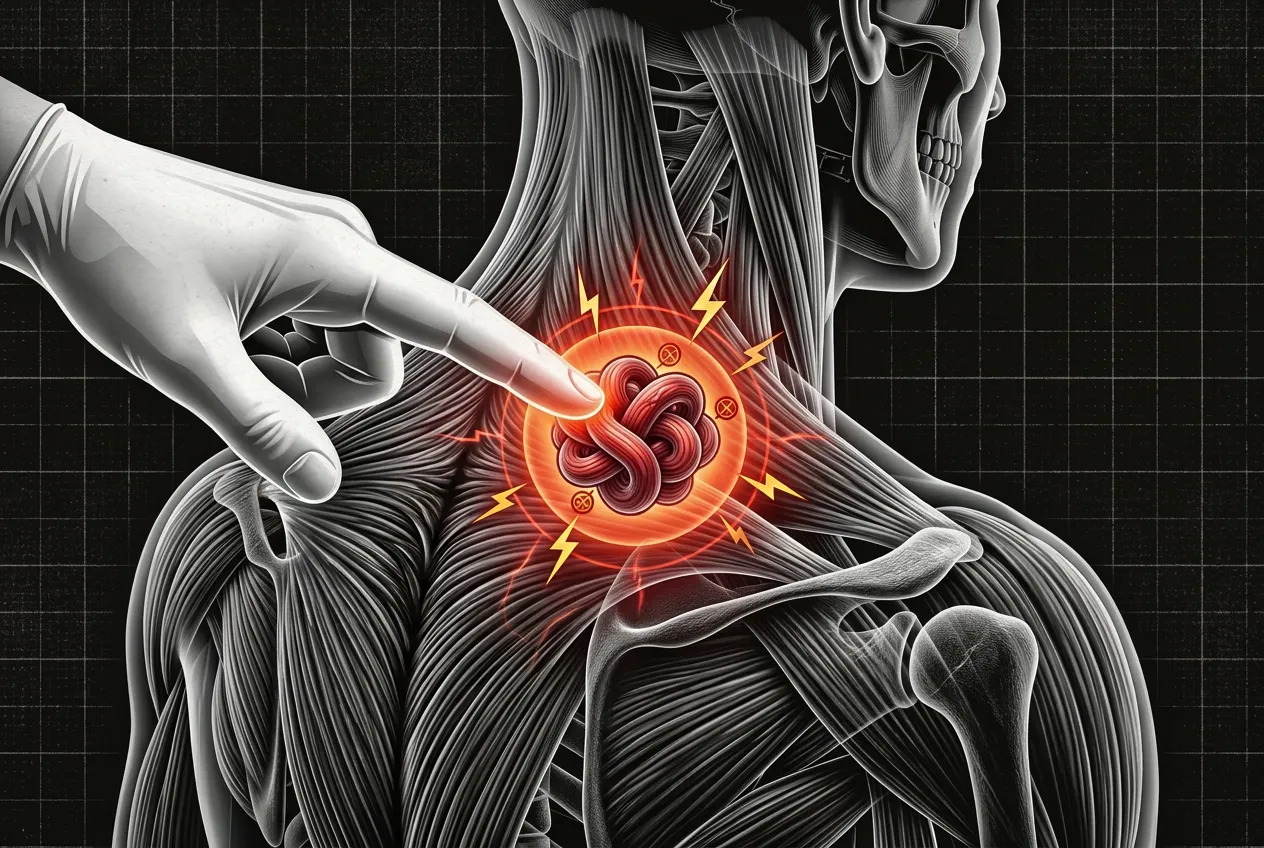
Apply Pressure: Press firmly and directly onto the most painful centre of that spot.
The Verdict: Does the muscle suddenly twitch under your finger? Do you involuntarily flinch or "jump" from the intensity?
The Science: You have found an Active Trigger Point. This is a clinical contraction that has run out of oxygen (Hypoxia) and is physically unable to "unplug" itself.
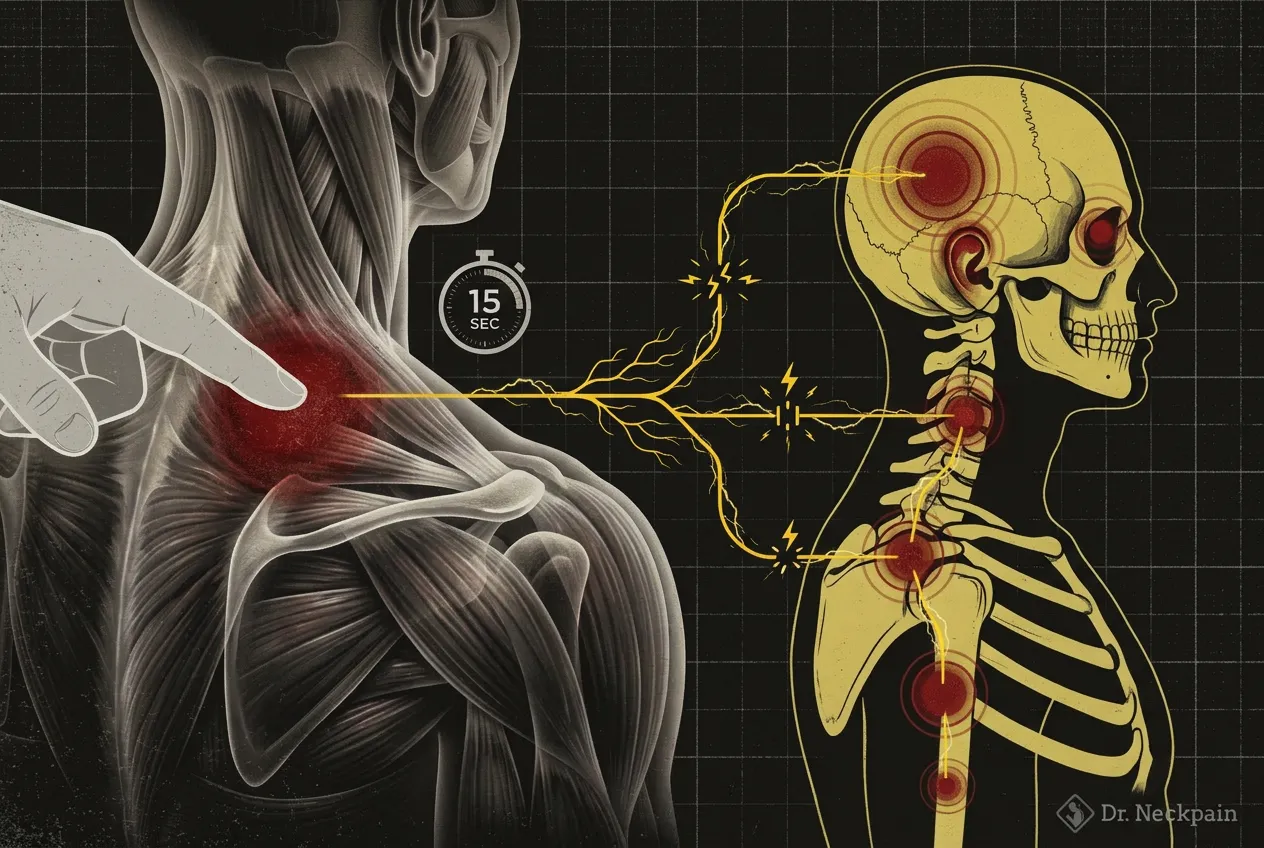
Trigger points are "dishonest"; they often send pain to places where the problem doesn't actually exist.
Locate the Source: Find a knot at the very top of your shoulder (the Trapezius) or the side of your neck.
Hold the Press: Maintain firm pressure on that spot for 15 seconds.
The Verdict: Do you feel a "zing," a deep ache, or a tingling sensation travel upward to your temple, behind your eye, or down your arm?
The Science: This is Referred Pain. It confirms that your headaches or arm tingling are actually coming from a "short circuit" in your neck muscles, signalling a failure in the muscle-nerve communication.
Healthy muscle should feel like a soft steak; a Myofascial muscle feels like a bundle of cables.
The Guitar String Technique: Use your thumb and index finger to "pluck" across the muscle fibres (perpendicular to the muscle).
Search for the Cable: Feel for a localised, hardened strand within the larger muscle.
The Verdict: Does it feel like a hard guitar string or a tight cable rather than soft, pliable tissue?
The Science: This is a Taut Band. It is the physical evidence of a muscle that has lost its ability to relax, creating a constant state of micro-tension that leads to that "tight corset" feeling.
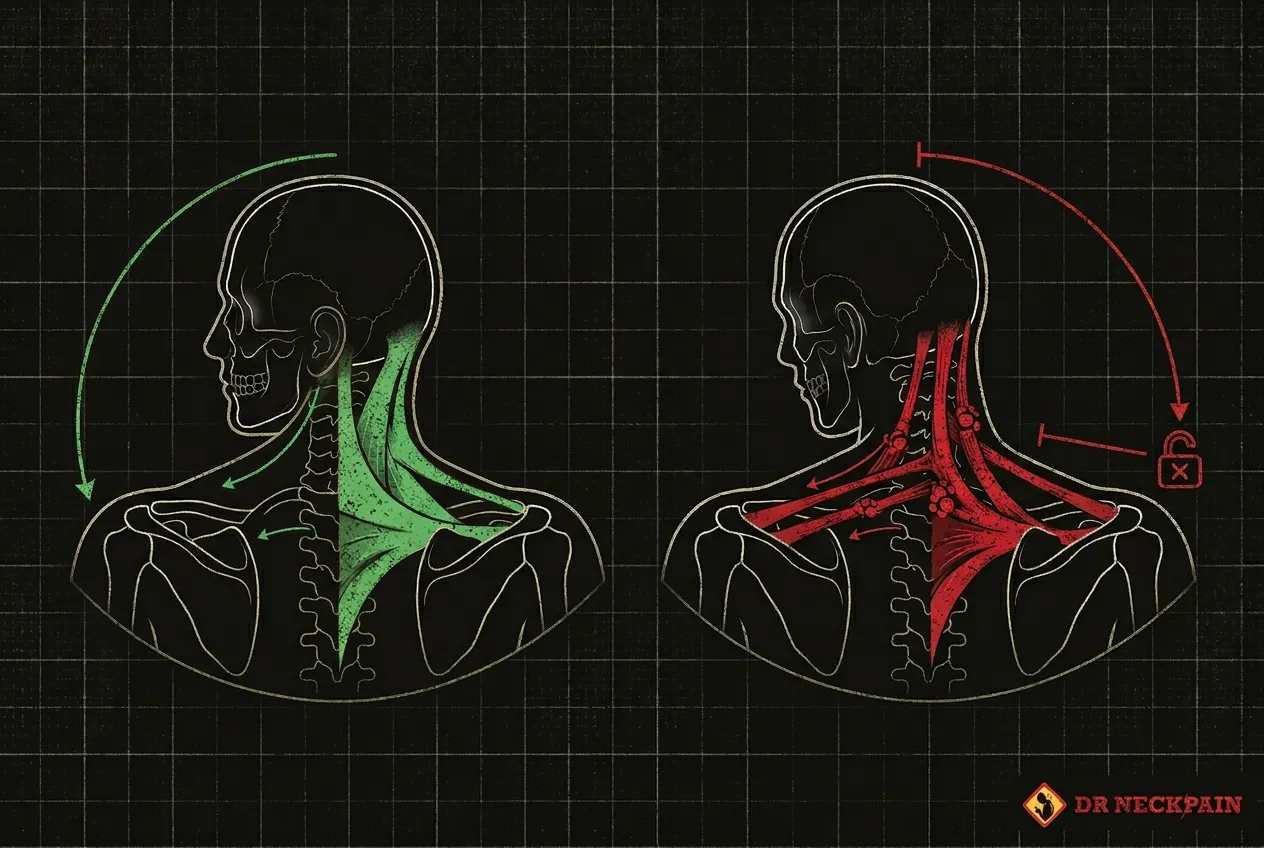
When trigger points are present, muscles stop working as individuals and fail as a team.
The Rotation Test: Sit up straight and turn your head fully to one side. Can your chin reach parallel to your shoulder?
The Logic: If your motion is blocked by a "stiff cable" feeling, it involves a failing unit of the Trapezius, Levator Scapulae, and Splenius muscles.
The Verdict: If you checked "Yes" to one or more of these tests, your pain is not just "stress" or "posture." It is a functional crisis in your soft tissue. Because these knots have run out of oxygen, they are physically stuck in the "ON" position, a state known as a persistent contracture.
DISCOVER YOUR GHOST PAIN
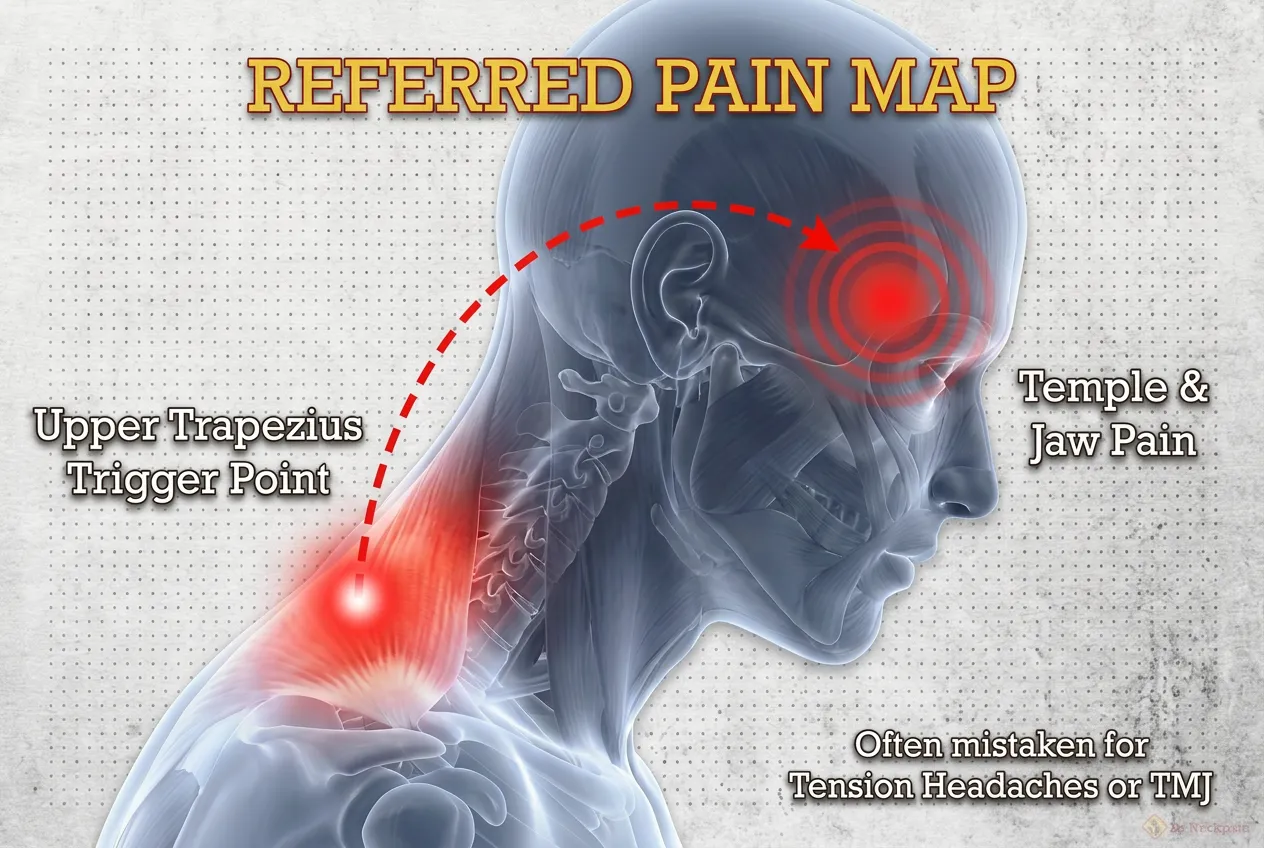
Stop treating the "destination" and start treating the "source." In our Bugis clinic, we see hundreds of patients who have spent months treating the wrong body part. Tracing the Referred Pain Map is the first step to a permanent resolution.
Pain in the Temple or Jaw?
The Likely Source
Upper Trapezius (The "Stress Headache Producer").
The Misdiagnosis
Often mistaken for simple tension headaches or TMJ. If your "migraine" feels like it's coming from your shoulder, it's a Trapezius trigger point.
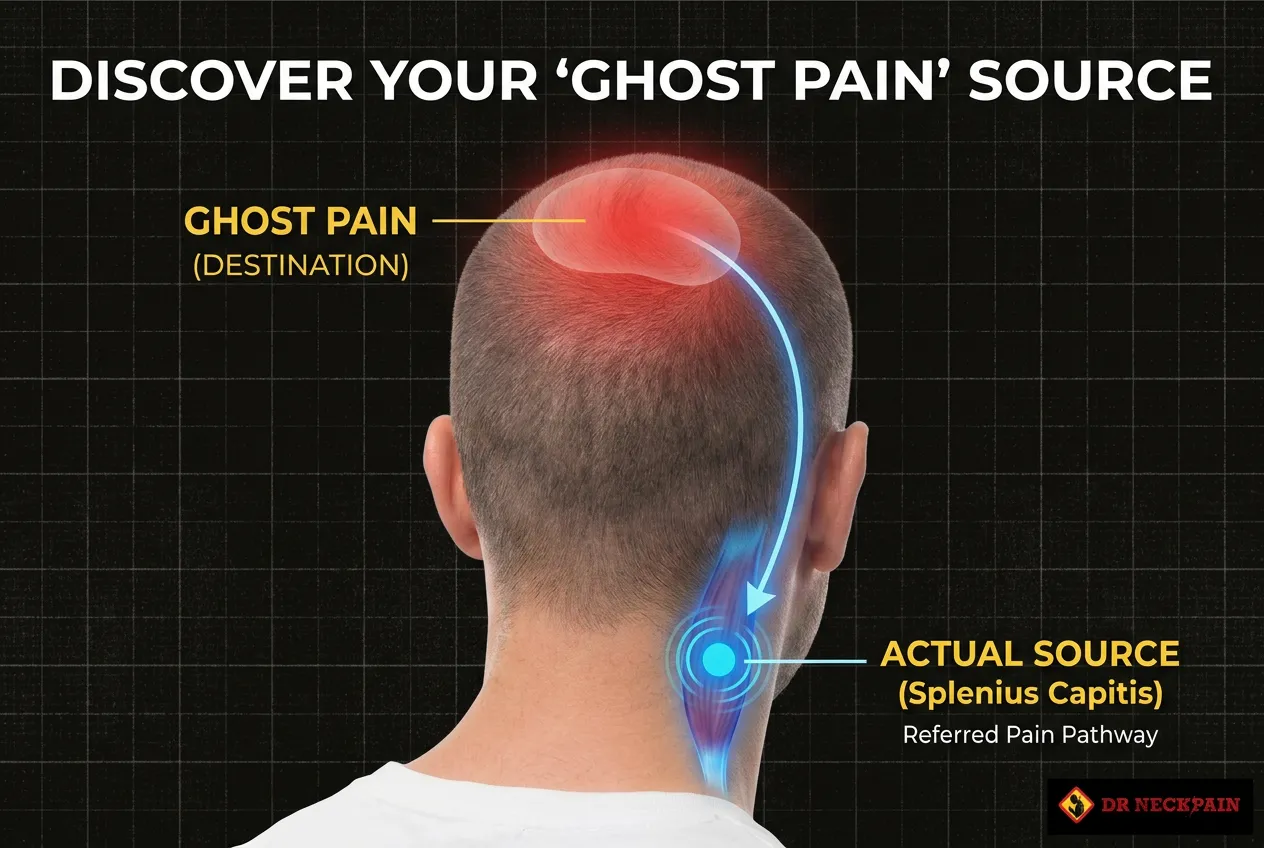
Pain at the Crown (Top) of the Head?
The Likely Source
Splenius Capitis
The Misdiagnosis
Often mistaken for high blood pressure or sinus pressure. This muscle at the "corner" of your neck refers pain directly to the vertex of your skull.
Pain Deep Behind the Eye?
The Likely Source
Splenius Cervicis.
The Misdiagnosis
Frequently misdiagnosed as Occipital Neuralgia. Research shows this refers to pain that "shoots through the head" to the back of the orbit.
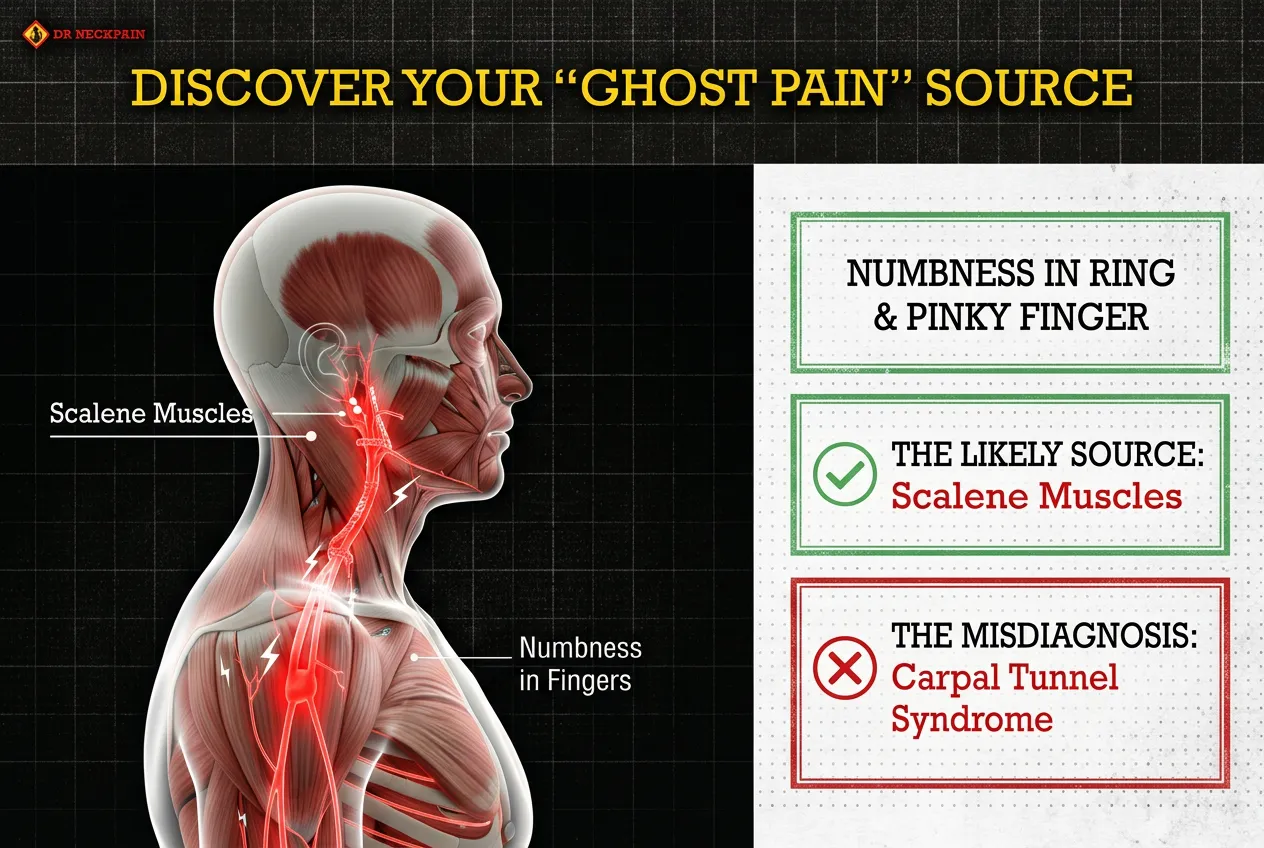
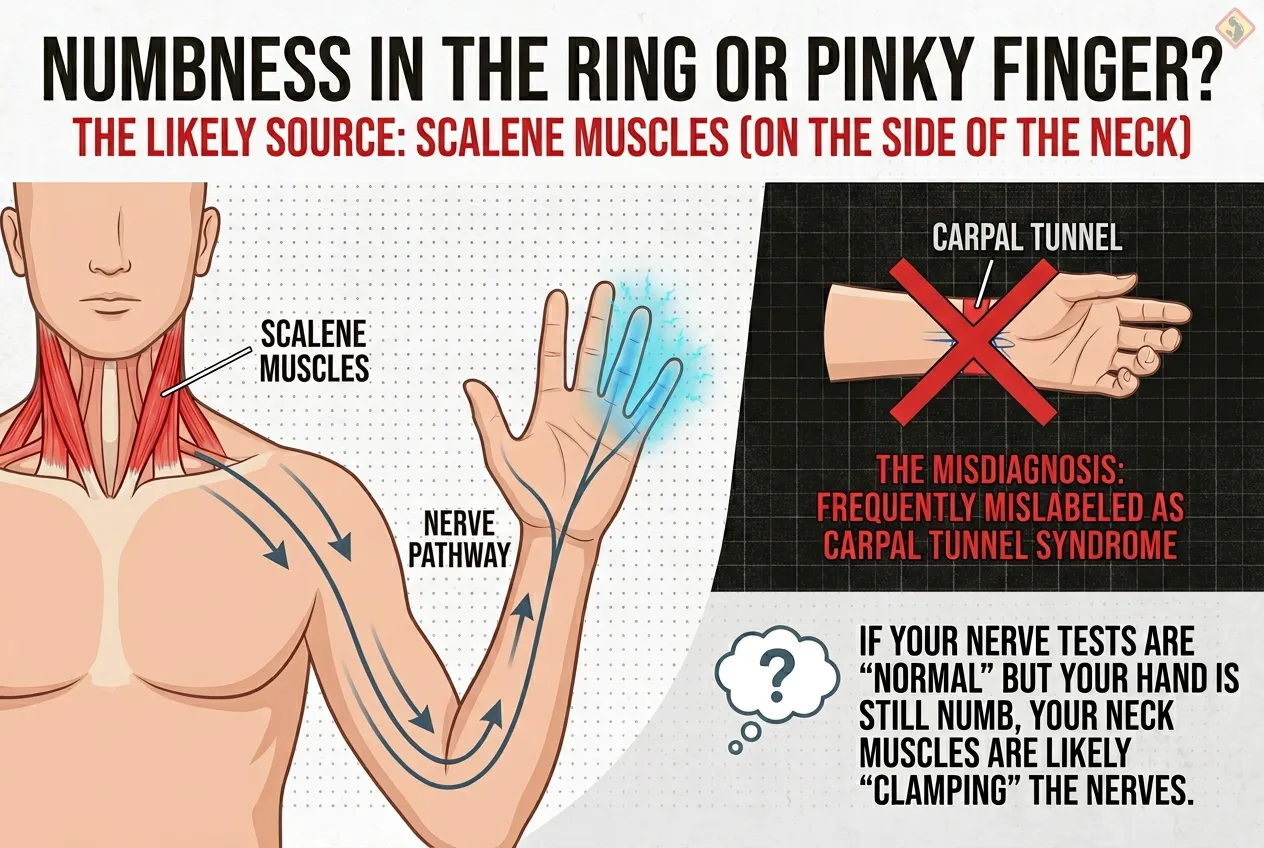
Numbness in the Ring or Pinky Finger?
The Likely Source
Scalene Muscles (on the Side of the neck).
The Misdiagnosis
Frequently mislabeled as Carpal Tunnel Syndrome. If your nerve tests are "normal" but your hand is still numb, your neck muscles are likely "clamping" the nerves.
If you have already tried "fixes" like Deep Tissue Massage, Dry Needling, or Muscle Relaxants (like Anarex) and the tension returned within 48 hours, there is a clinical reason for your frustration: Your muscles aren't tightening because they are "angry"; they are tightening because they are protecting you.
The "Missing Link": The Biological Splint
In 90% of chronic cases, your large muscles (like the Trapezius) act as a "Biological Splint." Their job is to stabilise a misaligned cervical spine
The Trap: If you "release" the muscle via massage or a needle without fixing the underlying spinal alignment, your brain will immediately send an emergency signal to tighten that muscle back up to protect the joint.
The Solution: To get permanent relief, you must Reset the Hinge (the Bone) so the Cable (the Muscle) can finally let go.
One of the most confusing aspects of Myofascial Pain Syndrome is its ability to 'mimic' other serious conditions through referred nerve pathways. When an underlying spinal shift creates joint instability, your nervous system forces your muscles into a state of chronic guarding. Because of this Referred Pain mechanism, you may be seeking treatment for the destination rather than the structural source.
Unlike a simple bruise, a Myofascial Trigger Point is "dishonest." It sends pain signals along nerve pathways to distant sites.

The "Fake" Carpal Tunnel
You feel numbness in your hand, but the source is actually a knot in your Infraspinatus (shoulder blade) or Scalenes (side of neck).
.avif)
The "Fake" Migraine
You feel a throbbing behind your eye, but the source is your Upper Trapezius.
.avif)
The "Fake" Earache
You feel pressure in your ear or jaw, but the source is your Sternocleidomastoid (SCM) Muscle.
In Singapore, these two are often confused, leading to incorrect "blanket" treatments. Understanding the difference is the key to getting your life back.
THE FUNCTIONAL GAP
Patients often ask, "If it's a hard cable, why didn't my MRI see it?"
The MRI Limit
An MRI is like a photo of a car's engine while it is turned off. It can detect whether a part is physically broken (structurally).
The Myofascial Reality
Trigger points are a problem with the software and electrical (functional) systems.
The Logic
The Integrated Hypothesis proves these knots are microscopic "short circuits." You cannot see a short circuit in a still photo; you have to test the "Fuse Box" (the spine) and the "Cables" (the muscles) while they are in motion.
The "Slipped Disc" Distraction
We often see Singaporeans terrified by a "Bulging Disc" on their report. However, the Trigger Point Manual notes that 96% of healthy people have disc bulges with zero pain.
The Reality:
Your pain is often coming from the protective guarding (the Biological Splint) around the disc, not the disc itself.
The Solution:
By correcting your spinal architecture, we relax the "Splint," which often relieves "disc pain" without surgery.
TRIGGER POINT TYPES
Unlike generic "soreness," Myofascial Pain Syndrome involves specific types of palpable nodules within the muscle fibres. To provide a permanent cure, we must identify which type is driving your dysfunction:
These are the most aggressive. They cause pain constantly, even when you are resting at home. They are the source of that deep, burning ache that distracts you during meetings.
Pressing on an Active Point often triggers a "Jump Sign", an involuntary flinch due to the extreme sensitivity of the nerve.
These are "silent" killers of mobility. They don’t hurt until they are pressed, but they are the reason your neck feels "stiff" or "heavy." Latent Points are why you can’t turn your head fully to check your blind spot while driving on the PIE or ECP. If left untreated, they often become Active during periods of high stress.
These develop in a chain reaction. When a primary muscle fails, the surrounding muscles try to compensate.
The Trap:
A structural issue in your Neck (C5/C6) creates a Primary Point. Your brain then creates a Satellite Point in your shoulder blade to help out. Treating the shoulder blade alone is a waste of time; it will only resolve once the Neck is corrected.
These form due to Postural Distortion. If your chest muscles are shortened from hours of slouching over a laptop, your upper back muscles are forced into a permanent stretch. These overstretched back muscles develop Secondary Trigger Points as they struggle to pull your shoulders back into place.
While stress can aggravate tension, true Myofascial Pain Syndrome is a mechanical breakdown. In our Singapore clinic, we identify the three primary drivers that keep your muscles in a state of chronic failure:
The human head weighs about 5kg, but for every inch it tilts forward, its effective weight doubles. In Singapore’s high-pressure work culture, holding your head forward (Forward Head Posture) for 8–10 hours a day creates a low-grade, constant strain. This "Static Load" causes microscopic tearing and scarring of the fascia, leading to permanent knots.
Old car accidents (even minor "fender benders" on the AYE), sports falls, or childhood injuries leave behind scar tissue. This creates Fascial Adhesions, literally "glueing" your muscle fibres together. These adhesions prevent the muscle from sliding smoothly, creating a permanent "catch" in your neck's range of motion.
Recovering from Whiplash & Invisible Trauma >
This is the most overlooked factor. Your muscles are slaves to your bones. If a vertebra in your neck is "locked," misaligned, or has lost its natural curve, your brain perceives the spine as unstable. To prevent injury, the surrounding fascia thickens and hardens, forming a Biological Splint. This thickening is the Trigger Point.
Until the structural alignment is restored, the muscle will refuse to let go.
Managing Stiffness from Cervical Spondylosis & Arthritis >
THE DEEP SCIENCE
To fix a chronic trigger point, you must understand that you are not dealing with "tightness." You are dealing with a microscopic physiological failure.
Based on the Integrated Hypothesis - the gold standard in myofascial research - a trigger point is a state of Persistent Contracture.
THE CALCIUM LEAK
Repetitive strain (from WFH or Tech Neck) causes a microscopic calcium leak at the point where your nerve meets your muscle.
THE "ON" SWITCH
This leak keeps your muscle fibres permanently contracted.
OXYGEN BLOCK (Hypoxia)
This constant "clamping" squeezes your local blood vessels shut, cutting off oxygen.
THE CRISIS
Your muscle is literally starving for oxygen, which prevents it from having the energy (ATP) to "unplug" the knot. The muscle is physically stuck in the "ON" position because it has run out of fuel to turn itself off.
‼️ THE RESULT
Your brain will not allow the muscle to relax as long as it perceives the underlying joint is unstable. This is why stretching often makes the pain worse: you are trying to pull apart a splint that your brain is desperately trying to hold together.
It is frustrating to be told "nothing is wrong" when you are in daily agony. Standard hospital scans are designed to detect Structural Breaks (such as fractures or slipped discs). They are effectively blind to Functional Pain.
INVISIBLE CRISIS
Myofascial pain lives in the soft tissue and the nervous system. An MRI cannot see a "calcium leak" or "hypoxia." Your pain is real, but it is "invisible" to a machine.
THE SOLUTION
We specialise in the Functional Physical Exams required to locate these hidden trigger points. We don't just look at the engine photo; we test the electrical system while the car is running.
Why does Myofascial Pain seem so much more aggressive in Singapore? Our unique environment creates "Perpetuating Factors" that keep your knots hyper-irritable.
.avif)
The "Air-Con" Effect
Moving between 32°C humidity and 18°C CBD offices triggers "Micro-Shivering". This sudden temperature drop keeps your muscles in a state of micro-contraction, physically preventing the Energy Crisis in your knots from healing naturally.
.avif)
The Vitamin D Gap
It is an irony of life in the tropics: because we spend our daylight hours in high-stress, indoor offices in the CBD, widespread Vitamin D and Iron deficiencies are common. Research in the Trigger Point Manual shows these deficiencies make your muscles hyper-irritable, causing knots to return even after treatment.
.avif)
The 27kg Penalty
For every inch your head leans forward into "Tech Neck" (scrolling on the MRT or working at Mapletree Business City), you add nearly 5kg of effective weight to your spine. This static loading forces muscles like the Levator Scapulae to work 3x harder than they were designed for.
Correcting Forward Head Posture & Tech Neck >
.avif)
The TMJ & Headache Connection
Research confirms that Forward Head Posture (FHP) is a major risk factor for chronic headaches and TMJ (Jaw) pain. When your neck stabilisers fail, the muscles of your jaw and temple overwork to compensate for the structural shift. This is why many "jaw problems" in Singapore are actually unresolved neck trigger points.

Acute pain is easier to fix; chronic pain (6+ months) changes the nervous system and has a "worse prognosis".
Myofascial pain is much easier to resolve in the Acute Stage. Once pain persists for more than 6 months, it becomes Chronic, making the trigger points harder to release and the recovery path longer. If you’ve been "managing" your pain for weeks, now is the time to act. Early intervention is the difference between a quick fix and a long-term struggle.
THE MULTIMODAL APPROACH
The clinical papers we utilise are clear: Myofascial Pain Syndrome is an interprofessional problem. It requires a solution that addresses both the structural "Hinge" and the biological "Cable" simultaneously.
WHERE OTHERS FALL SHORT
If you have already tried a few sessions elsewhere in Singapore and your "knots" returned within 48 hours, the treatment likely failed to address the Synergy of your injury.
The Physiotherapy Limit
"Strengthening a Bent Frame"
Most physiotherapy in Singapore focuses on stretching tight muscles and strengthening weak ones.
The Problem
You cannot "strengthen" a muscle that is stuck in an Energy Crisis. If the fibres are locked and oxygen-deprived (Hypoxia), adding more exercise can actually worsen the hypoxia and make the trigger point more aggressive.
The Missing Link
Physio often ignores the "Fuse Box" (the spinal joint). If the joint is misaligned, the brain will continue to use the muscle as a Biological Splint, instantly re-tightening what was just stretched.
The General Chiropractic Limit
"The Blind Adjustment"
High-volume clinics often focus on a quick, generic "crack" without addressing the soft tissue.
The Problem
Muscles have a "memory" of pain. If a chiropractor adjusts the bone but ignores the Taut Bands in the muscle, those rigid "cables" will act like high-tension wires, pulling the bone right back out of alignment within hours.
The Missing Link
Without clinical Myofascial Release, the adjustment won't "hold."
THE DIFFERENCE
We utilise the Multimodal Approach, as recommended by the latest clinical research, to treat the entire functional unit of your neck.
Most clinics in Singapore treat the muscle and the bone as separate entities. At Dr Neck Pain, we specialise inMuscle-Joint Synergy. We understand that a chronic knot is almost always a secondary symptom of a primarystructural failure in your spine.
Clinical research confirms that active trigger points in the neck, specifically within the Upper Trapezius, do not appear at random. They correlate directly with spinal dysfunction and joint restriction at the C3 and C4 levels.
THE STRUCTURAL LINK
When these specific vertebrae lose their natural alignment, the nerves responsible for controlling your shoulder muscles become irritated.
THE RESULT
Your brain locks the muscle into a permanent state of contraction to protect the unstable joint. This is the origin of the "rock" in your shoulder that never goes away with massage alone.
While a spa massage or a simple stretch might temporarily soothe a sore muscle, the "Integrated Hypothesis" proves that you must address both the structural and chemical components of the injury to achieve a permanent cure.
Structural Reset
A precise spinal adjustment instantly changes the pain sensitivity of a trigger point by removing the neurological "guarding" signal.
Myofascial Release
Once the spine is stable, we physically "unplug" the chemical excess and stagnant calcium at the muscle level. This dual action is the only way to prevent the knot from returning.
As Structural Correction Specialists, we don't just "crack" the neck for short-term relief. We use forensic X-ray analysis to identify the exact millimetric shifts at the C3–C4 level that are feeding your Myofascial Pain. By restoring your spinal architecture, we eliminate the body's need for a "Biological Splint," allowing your muscles to remain soft, pliable, and pain-free
The Solution
I understand the sheer exhaustion of living with "rocks" in your shoulders and a neck that feels like it's trapped in a permanent corset. You've likely tried self-medicating with Panaflex patches, Tiger Balm Plasters, or Salonpas from Guardian, only to find the relief disappears the moment you peel them off.
Perhaps you've even been prescribed muscle relaxants like Anarex or Myonal by a GP, only to find they make you drowsy at your desk while the deep, "locked" tightness remains. It's frustrating when you're told to "just relax," but your muscles physically won't let go. That is because you aren't dealing with simple tension; you are dealing with a microscopic Energy Crisis triggered by your cervical spine.
29 Years of Specialisation
With nearly three decades of clinical practice, 20 years in Singapore, I specialise in identifying the mechanical "short circuits" that keep your muscles in a state of Protective Guarding.
Structural, Not Symptomatic
While standard treatments only "rub the victim" (the muscle), our R3NEW X™ program targets the complex relationship between your spinal architecture and your soft tissue. By restoring the structural alignment of your "Fuse Box," we stop the brain from sending the emergency signals that create chronic Trigger Points, allowing your body to finally "unplug" the pain at its source.
BENEFITS
Most treatments in Singapore provide only a "temporary truce" with your pain. The R3NEW X™ protocol aims for a permanent resolution by addressing the physiological and structural triggers of Myofascial Pain Syndrome..
.avif)
.avif)

Because Myofascial Pain is "The Great Mimicker," it is easy to confuse it with other spinal conditions. Use this quick guide to find the correct specialised care for your specific symptoms:
Tap a symptom to find out what's really going on:
THE PROTOCOL
We don't just "feel" for knots; we calculate the mechanical reason they exist. Our program is a coordinated reboot of your neurological and structural systems.
We perform a forensic physical assessment to identify your specific Referred Pain Maps. Using precision X-ray analysis, we measure the alignment of your cervical spine to locate the "Biological Splint", the structural shift that is forcing your muscles into a state of permanent guarding.
We utilise a specialised clinical approach to resolve the three stages of muscle failure:
RELEASE
We physically break the Energy Crisis cycle through clinical trigger-point release or dry needling. This flushes out stagnant calcium and allows oxygenated blood to "reboot" the muscle fibres.
RESET
We correct the underlying spinal misalignment (The Fuse Box). By restoring structural integrity, we stop the brain from sending the emergency signals that cause your muscles to lock up.
RECALIBRATE
We retrain your nervous system to stop the chronic "guarding" patterns. This ensures your muscles stay relaxed even during high-stress 12-hour workdays in the CBD.
Experience the return of a light, mobile neck. By decompressing nerve pathways and restoring spinal architecture, we eliminate the "heavy bowling ball" feeling and the phantom numbness in your arms. You regain the strength and flexibility to return to your daily life in Singapore, from high-intensity training to demanding office work, without the fear of your "knots" returning.
THE DIFFERENCE
Most clinics in Singapore treat Myofascial Pain Syndrome by focusing solely on the muscle through dry needling or massage. While these provide temporary relief, they rarely offer a permanent cure because they ignore the "Biological Splint", the structural reason your brain is keeping the muscle tight.

Join 3,000+ patients in Singapore who have graduated from "temporary relief" to permanent structural stability. Clear the "heavy bowling ball" feeling and reclaim your mental focus with X-ray-proven Structural Correction.
You shouldn’t have to "survive" your workday with Tiger Balm or live in constant fear that a long meeting will trigger a "Ghost Pain" attack behind your eye. Whether it is the Energy Crisis causing a deep, heavy ache in your shoulders or a Biological Splint capping your neck’s range of motion, the problem isn’t your stress; it is a mechanical failure of your spinal alignment.
Our R3NEW X™ Myofascial Protocol is the precise, drug and surgery-free solution designed to "unplug" the persistent contracture in your muscles and decompress the nerve pathways at the base of your skull. We identify and reverse the structural misalignment in your neck to permanently eliminate the mechanical triggers that spark your pain.

Our 90-Day "Structural Stability" Guarantee
We are the only clinic in Singapore that stands by our work with a Structural Guarantee: We will objectively improve your Upper Cervical alignment, reduce the spinal pressure triggering your Myofascial Pain, and improve your structural stability in 90 days, or we will refund your entire treatment fee.
We don't just promise the pain will stop; we prove the structural change with post-correction X-ray imaging.
T&C Applies.
The "Myofascial Trigger" Analysis
Book your initial consultation, which includes a complete "Ghost Pain" mapping, neurological examination, and precise X-ray analysis to locate exactly where your muscle triggers are originating.
The "Structural Source" Verdict.
We review your X-rays together to determine how C3-C4 misalignment, or "Tech Neck," is feeding your knots, and to map out your custom 90-day restoration plan.
The Tension-Free Living
Start your R3NEW X™ journey and experience the relief of a "light," mobile neck, so you can work, exercise, and keep your plans without the fear of your knots returning.
Conveniently located at North Bridge Centre, our clinic is the preferred choice for high-performing professionals in Bugis, City Hall, and the Singapore CBD. Whether you feel a "Ghost Pain" headache starting at your desk in Raffles Place or you are struggling with a "heavy bowling ball" neck that makes it impossible to focus in your Tanjong Pagar office, we are easily accessible for urgent structural relief.
We understand the specific demands of the Singapore corporate lifestyle, the 12-hour workdays at Mapletree Business City, the "Tech Neck" strain of the MRT commute, and the cold air-con drafts that keep your muscles in a permanent Energy Crisis. That is why our appointment slots and R3NEW X™ protocols are designed for efficiency and long-term resolution, not just temporary symptom masking.
The R3NEW X™ Approach
While a GP may prescribe Anarex to mask the pain, we use X-ray guided correction to fix the spinal misalignment (the "Biological Splint") that is actually forcing your muscles to lock up.
Executive-Friendly Timing
Lunchtime and after-work slots are reserved for busy executives who need to relieve neck tension without disrupting their meeting schedule.
No "Package Traps"
Our goal is Structural Stability. We aim to correct the root cause of your Myofascial Pain Syndrome so you can stop the endless cycle of weekly massages and Salonpas patches.
Clinical Environment
A professional, quiet space designed for patients who need a reset from the high-decibel stress of the city.
Find Us in the Heart of Singapore
📍 Clinic Address: 420 North Bridge Rd, #02-20 North Bridge Centre, Singapore 188727
🚇 MRT: 5-minute walk from Bugis MRT (East-West & Downtown Lines) or City Hall MRT Station
🅿️ Parking: Available at National Library of Singapore, Bugis Junction, and InterContinental Singapore
We are the trusted structural correction specialists for residents and professionals seeking specialised myofascial care not found in general chiropractic clinics:

Central Residential Areas
Orchard, River Valley, Tanglin, and Newton.

Primary Business Hubs
Tanjong Pagar, Raffles Place, Marina Bay,and Suntec City.

The Heartlands
We frequently welcome patients travelling from Tampines, Jurong, and Bishan who have "tried everything" elsewhere and are seeking a final, structural solution for their chronic knots.
Every recommendation at Dr Neck Pain Singapore is grounded in peer-reviewed research. Below are 4 published sources from Wolters Kluwer, Springer, Taylor & Francis and ScienceDirect, documenting the trigger point manual used worldwide, why muscles get stuck in an energy crisis, the clinical evidence for diagnosis and treatment, and why your pain shows up in one place but originates somewhere else.

Clinical References & Medical Sources
4 peer-reviewed sources: trigger point science, energy crisis pathophysiology & referred pain validation.