Stop Living Trapped by Years of "Invisible" Whiplash Pain
Singapore's leading neck correction specialist restoring the structural damage that standard acute hospital A&E departments often miss. We provide precise diagnoses and specialist documentation to break your chronic pain cycle and support your insurance claims.

Eliminated chronic whiplash pain and "heavy head" syndrome
Restored full neck mobility for safe driving and work
GIA-Compliant Specialist Medical Reports for trauma documentation
Clinically Reviewed by Dr Will Kalla › Lead Structural Correction Specialist | 29 Years Clinical Practice in Singapore [Last Reviewed: June 23, 2026]
.webp)
The Missing Diagnosis
The "A&E Gap": Why Your Neck Still Hurts Even if Your X-ray is "Clear"
If you went to A&E at SGH, TTSH, or Raffles after your accident, their primary job was to rule out life-threatening fractures. That’s why your report said, "Normal".
But "Not Broken" is not the same as "Healthy". At Dr Neck Pain, we look for the Mechanical Failure that standard hospital tests miss. We use three specific medical benchmarks to find the source of your pain:
01
.avif)
The S-Curve
(The "Heavy Head" Culprit)
Your spine is forced into an abnormal shape it was never meant to hold.
- When you get hit from behind, your lower neck slams backwards while the top snaps forward.
- Research (Cusick, 2001) refers to this as the "S-Curve".
- It forces your spine into an abnormal shape it was never meant to hold. This is why your head feels like a heavy bowling ball; your spine has physically lost its ability to carry the weight.
02
.avif)
Stretched Ligaments
(The "Invisible" Tear)
Too small for a standard hospital X-ray to detect, but enough to cause years of pain.
- Think of your ligaments as the "tape" holding your spine together.
- Even a small "fender bender" creates enough force (Ivancic et al., 2007) to stretch that tape by less than 1mm.
- This is too small for a standard hospital X-ray to detect, but it’s enough to make your neck feel unstable, stiff, and "tight like a corset" for years.
03
.avif)
The 3.5mm Rule
(Objective Proof of Injury)
If your spine shifts more than 3.5mm during movement, it is a verified "Structural Failure."
- We measure the "slide" of your neck bones down to the millimetre.
- Medical standards (Panjabi, 1998) state that if your spine shifts more than 3.5mm during movement, it is a verified "Structural Failure."
- This provides the objective proof you need for your GIA insurance claim to show that your injury is real, even without a broken bone.
Understanding Your Pain
The "Self-Assessment" Visual Guide
Standard physical therapy often fails whiplash victims because it treats the muscles, the "victims" of the injury, rather than the structure. Use the visual guide and the interactive tool below to identify if your symptoms correlate with trauma-induced instability.
1
Perform the Physical Tests
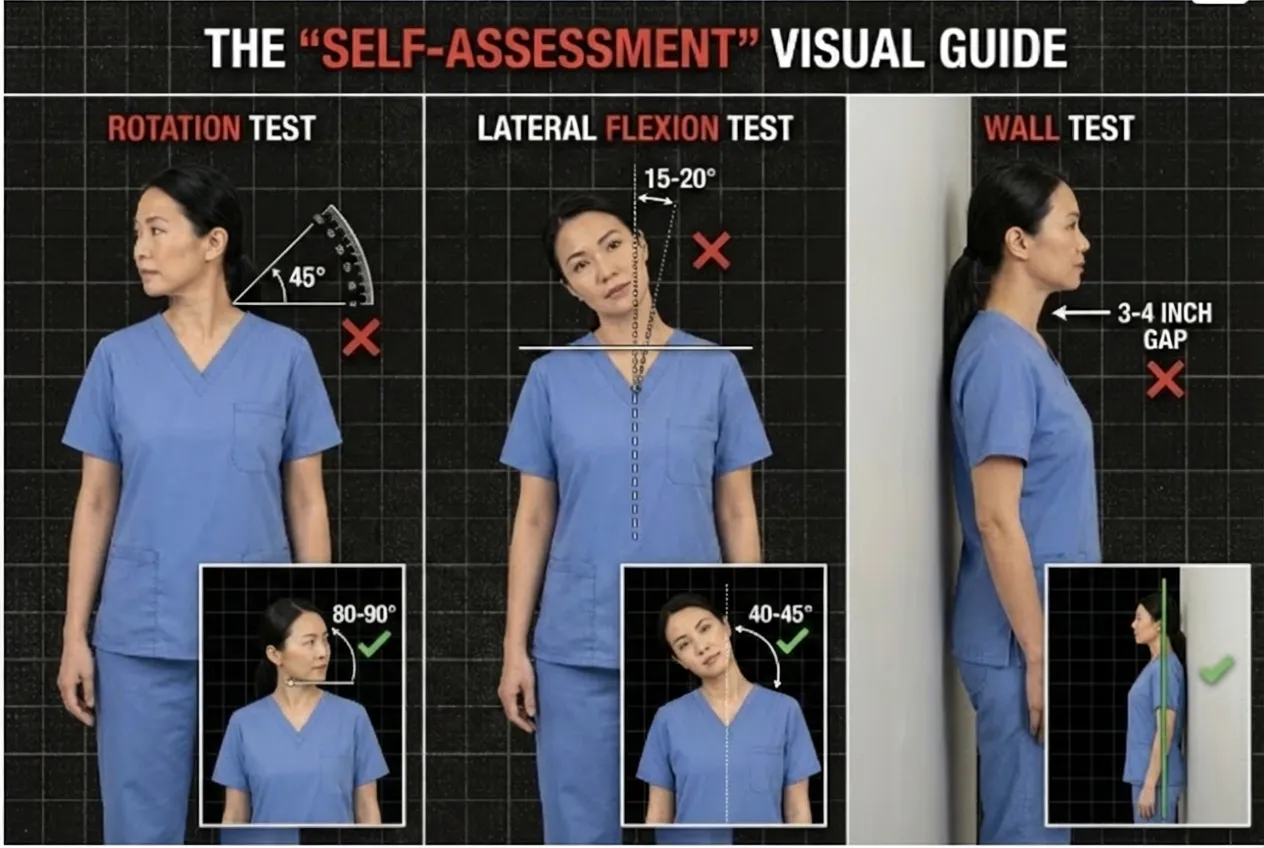
01
The Rotation Test
Turn your head slowly toward your shoulder. Note if you feel a sharp "stop" or if your chin cannot reach parallel to your shoulder.
02
Lateral Flexion
Tilt your ear toward your shoulder. Note any "pinching" on the tilt side or "stiff cable" feeling on the opposite side.
03
The Wall Test
Stand with your heels and shoulder blades against a flat wall. Can your head comfortably touch the wall, or is there a significant gap?
2
Use our clinical screening tool below to assess your structural risk level:
.png)
Free Self-Assessment
Your Whiplash Pain Won't Go Away Because the Trauma is "Invisible" to Standard Tests
You've been told "nothing is broken" at the A&E, but you feel like your head is a bowling ball that yourneck can no longer support. Take this 2-minute assessment to evaluate your structural injury risk.
Why "Close Enough" Isn't Good Enough
Physics shows that for every inch your head shifts forward from its centre of gravity, it gains 4.5kg to 5kg of "effective weight" on your spine. If you failed any of these tests, your whiplash isn't "healed". It has simply become a chronic structural burden that will lead to Early Onset Spondylosis if left uncorrected.
💡 CLINICAL INSIGHT
Many whiplash victims in Singapore are treated for 'Carpal Tunnel' (Numbness) or Tension Headaches for years, only to find the root cause was a "short circuit" in their neck from an old accident.
The Hidden Truth
Why "Minor" Accidents Cause Major Structural Damage?
A standard acute hospital A&E report often returns "clear" because emergency rooms are optimized to triage life-threatening fractures, not the complex mechanical forces that amplify trauma. The "invisible" damage to your cervical spine depends on physics and impact kinetics, not the amount of vehicle cosmetic damage:
.avif)
The 8mph Trap (Bumper vs. Spine)
You might have only been traveling at 13 km/h (8 mph) when hit. However, biomechanical research (Stemper et al., 2003) shows that even at this low speed, your head experiences a violent 5 to 18 G-forces of acceleration. Because modern bumpers are designed to bounce back rather than crumple, virtually none of the crash energy is absorbed by the car. Instead, it transfers directly into your spine.
This hidden damage happens in just 46 milliseconds,far too fast for your muscles to brace. The impact forces a severe "shear force" (a harsh sliding motion) onto your neck joints that is significantly more damaging than a straight impact (p < 0.0001). This instant mechanical failure stretches your ligaments, leaving your neck feeling stiff, heavy, and locked even when the car doesn't have a single scratch.
.avif)
The S-Curve Distortion & Head Position
(Cusick, 2001) found that the whip motion forces your neck into an abnormal "S-shape," stretching the deep ligaments. This damage is severely magnified if your head was turned (checking a blind spot) at impact, localising the full force to one side of the vertebrae. Furthermore, if your headrest was more than 2 inches away, it failed to "catch" your head in time, multiplying the structural shift.
.avif)
Non-Awareness & The 48-Hour Delay
If you didn't see the hit coming, your muscles couldn't brace, forcing your ligaments to absorb the full traumatic force. Adrenaline masks this initial tear. The landmark Quebec Task Force study (Spitzer et al., 1995) found that whiplash symptoms actually peak 2 to 3 days after the impact. While surface swelling goes down, a significant percentage of victims go on to develop chronic symptoms that last past 3 months. This is why you might feel fine on the PIE, only to be unable to get out of bed two days later.
.avif)
"Accident Brain Fog"
If you've felt dazed, forgetful, or unusually irritable since the crash, it isn't just "stress." Clinical studies (Rebbeck, 2019) prove that whiplash often causes Brain Fog. The rapid snapping affects your nervous system's "fuse box," leading to real cognitive deficits.
.avif)
Pre-Existing Stability
If you already had mild arthritis or prior neck tension, your ligaments were less pliable before the crash. This dramatically increases the risk of developing chronic pain or "Late Whiplash Syndrome" years down the line if the new structural shift isn't corrected.
⚠️ The Airbag Paradox
Why Safety Features Can Magnify Whiplash
While airbags save lives in high-speed collisions, their deployment in low-speed crashes can introduce a "Secondary Whip" to the cervical spine. If your airbag deployed during a minor collision on the AYE or PIE, the inflation event itself may have caused more structural damage than the actual impact.

C1-C2 Risk
The "Secondary Whip" Effect
When an airbag inflates rapidly, it can drive the torso backwards while the head lags. This produces rapid extension and tension at the upper cervical spine (C1-C2), a common risk for smaller-framed drivers who must sit closer to the steering wheel.
.avif)
Vehicle Age
Legacy vs. Advanced Systems
Many older vehicles use "first-generation" airbags that deploy with a uniform, aggressive force regardless of crash severity. These legacy bags pose a higher risk of ligamentous injury in lower-severity impacts.
.avif)
C0-C2 Stress
Head Rotation & The "Fuse Box"
If your head was turned when the bag deployed, the combination of rotation and tension concentrates extreme stress on the C0-C2 vertebrae. This explains why many patients report severe Traumatic Migraines after a "minor" airbag-triggering crash.
X-Ray EVIDENCE
Objective Proof of the "Invisible" Injury
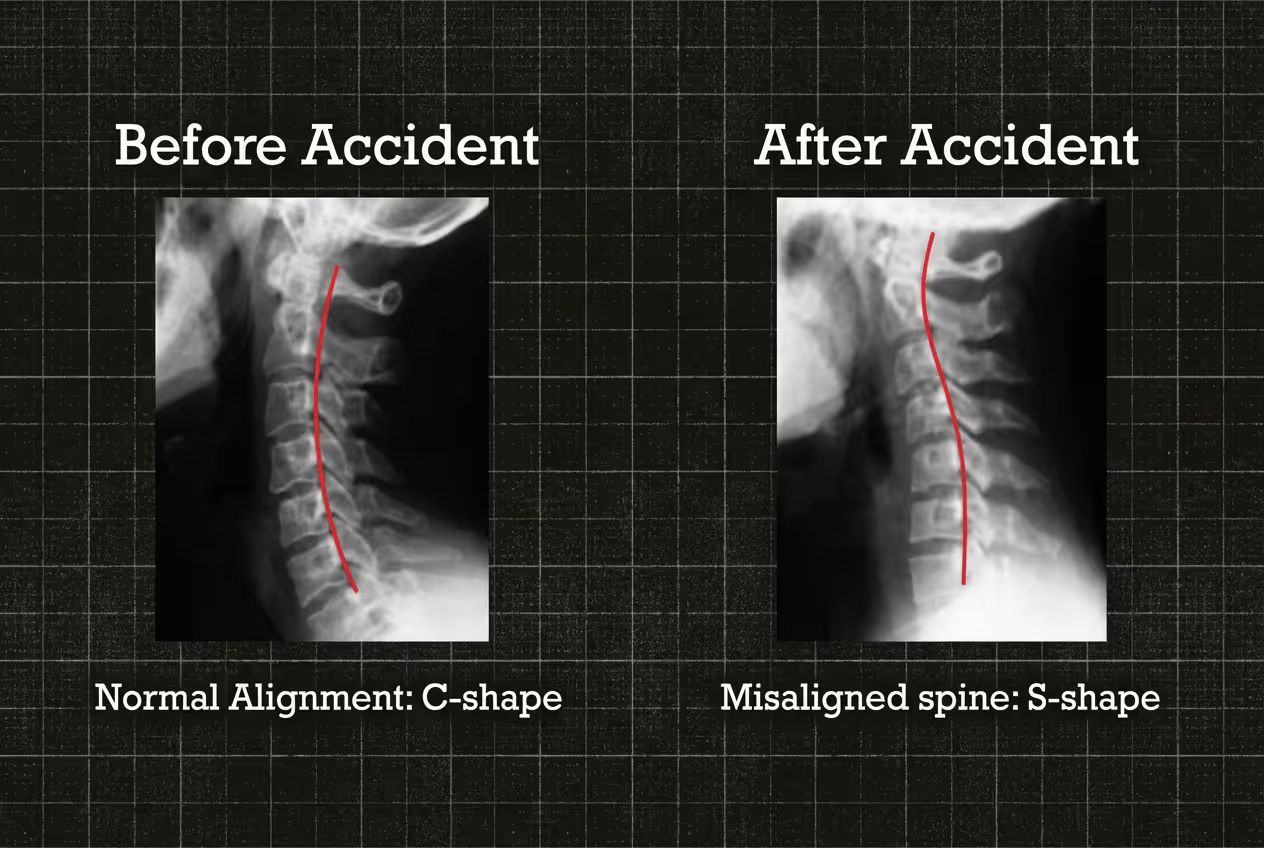
A standard A&E report often comes back 'clear' because there are no fractures. However, as these X-ray images show, the absence of a broken bone does not mean your spine is healthy
Before Accident (Normal Alignment)
The cervical spine maintains a healthy, forward-facing C-shape curve. This structure acts as a shock absorber, keeping your 5kg head balanced effortlessly over your shoulders.
After Accident (Misaligned Spine)
The trauma of whiplash has forced the spine into an abnormal S-shape. This structural failure indicates ligament laxity and causes the 'heavy head' feeling, chronic migraines, and deep muscle tension that painkillers cannot fix.
At Dr NeckPain, we use structural analysis to see what the hospital missed, providing you with the objective evidence needed for both your recovery and your insurance claims.
Your whiplash pain won't go away because treatments keep targeting symptoms instead of the cervical structural damage from your accident.
01
Severe pain when lifting your arms to put on a dress.
02
Barely able to sit at your desk for 15 minutes without radiating pain shooting up and down your neck and back.
03
Muscles that feel "too short, as if wrapped around like a corset" limit every movement you try to make.
04
Numbness & Tingling in your arms that appears in specific positions, making you fear permanent nerve damage.
05
Tension Headaches & Migraines that weren't there before your accident.
06
Morning stiffness that takes hours to improve, if it improves at all.
You've tried physical therapy that was "too rough," chiropractors who "made problems worse," and pain medications that leave you drowsy but still hurting.
Specialists who dismiss your pain as "just stiff muscles" when you know something deeper is wrong.
Thirteen years of pain, with some patients saying, "I'm at my wits' end, can't live with it anymore."
Here's what most practitioners don't understand: Your whiplash created structural damage to your cervical spine that traditional treatments can't reach.
The sudden acceleration-deceleration forces didn't just strain muscles, discs and ligaments - they disrupted the alignment and neurological function of your cervical vertebrae, creating chronic compensation patterns that keep regenerating your symptoms.
You feel trapped in a body that betrayed you, incapacitated for work, and desperate for solutions that actually address the structural damage rather than just managing the aftermath.
You shouldn't have to accept years of chronic pain when the cervical structural damage from your whiplash can be corrected, eliminating the source of your ongoing symptoms rather than just masking them.
The "Fuse Box" Connection
Your Neck is the "Fuse Box" for Your Upper Body
When trauma shifts the vertebrae, it creates a "short circuit" that causes symptoms far from the injury site.
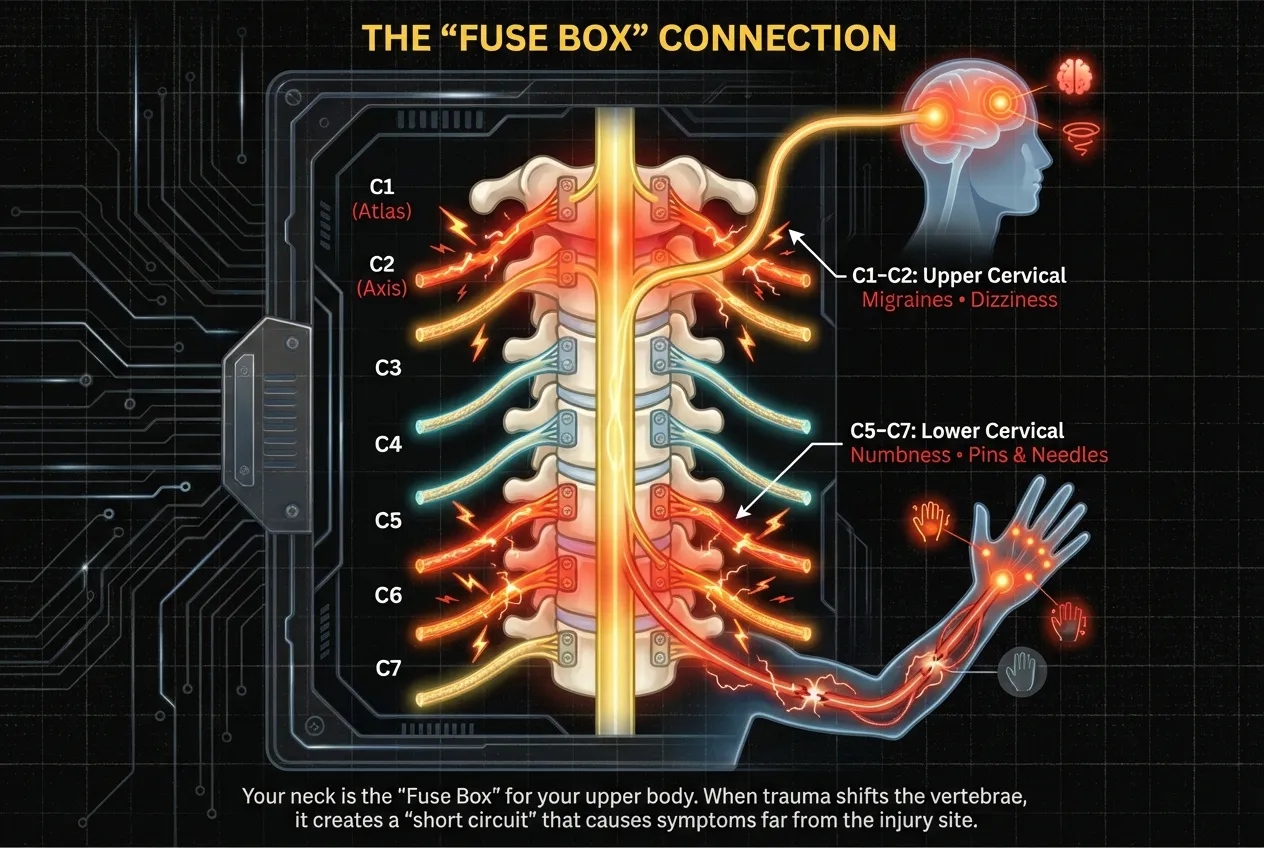
To understand why a neck injury causes pain in your head or fingers, think of your spine as the main fuse box for your body. When the 'whip' motion of an accident creates structural damage, it doesn't just hurt the bone; it 'short-circuits' the nerves exiting the spine.
Upper Neck (C1-C2)
POWER SUPPLY TO YOUR HEAD
These nerves act as the power supply to your head. Misalignment here is the primary mechanical trigger for Post-Traumatic Migraines caused by high-velocity trauma on Singapore's expressways.
Lower Neck (C5-C7)
NERVE PATHWAY TO ARMS & HANDS
These nerves travel down into your arms and hands. If these 'fuses' are compressed by a Cervical Disc Herniation or structural shift, you experience phantom Numbness & Tingling or weakness in your grip, symptoms that rubbing your arm will never fix.
Our R3NEW X™ Program focuses on decompressing these specific nerve pathways by restoring the structuralintegrity of the 'fuse box' itself.
Debunking Myths
Common Whiplash Myths vs. Clinical Reality
If you are fighting an insurance claim or dealing with a sceptical doctor, you have likely been told your pain isn't real. Here is the clinical, biomechanical reality:
Myth 1
It is just a muscle strain that will heal on its own in 6 to 12 weeks.
The Reality
Structural damage does not snap back on its own.
While surface swelling resolves in a few weeks, structural damage (such as the S-Curve misalignment) does not "snap back" on its own. Without corrective care, your muscles are forced to act as a permanent "protective corset" to stabilise the damaged joints, leading to decades of chronic stiffness.
Myth 2
Your pain is psychological, or you are just stressed about your claim.
The Reality
The Litigation Myth has been officially debunked.
Clinical research (Ferrari, 2003) has officially debunked the "Litigation Myth." Your recovery is dictated by physical ligament laxity and nerve compression, not your mindset. Furthermore, the irritability and "brain fog" you feel are real neurological symptoms of your "fuse box" short-circuiting.
Myth 3
There was barely any car damage, so your injury cannot be that bad.
The Reality
No car damage does not mean no spinal damage.
Modern cars are designed to minimise vehicle damage in low-speed crashes, which ironically transfers greater force directly into the passengers. Only a Forensic X-ray Analysis can reveal the true, objective extent of your injury.
Local Evidence
The "Singapore Gold Standard" for Whiplash Recovery
We align our methods with local clinical findings to ensure the best results for Singapore'sdrivers.
.avif)
The Best Approach in Singapore
"Multimodal Care" is the gold standard.
.avif)
Local research (Ng TS, et al. 2015) confirms Singaporean specialists agree:
"Multimodal Care"delivers the best outcomes.
You need a combination of spinal correction and specialised exercise to prevent your accident from becoming a permanent disability.
.webp)
Documentation for Your GIA Claim
Objective evidence insurers need to see.
.avif)
We provide the objective evidence that the General Insurance Association (GIA) and insurers needto see.
By documenting the exact "S-Curve" and the 3.5mm shift in your neck, we provide clinical proof that standard hospital reports miss.
The Comparison
TCM vs. Physiotherapy vs. Structural Chiropractic for Whiplash in Singapore
If you have been rear-ended on the AYE or PIE, you are likely deciding between several common care paths. Understanding the "depth" of your injury is key to choosing the right specialist. Stop masking the symptoms. Correct the structural "Fuse Box" trigger.
Specialist Verdict
If you’ve tried TCM or Physio for more than 4 weeks without a permanent change in your 'heavy head' feeling, you aren't dealing with a muscle problem. You are dealing with a structural failure that requires specialised correction.
Why Common Methods Often Fail Whiplash Victims
Most traditional treatments in Singapore fail because they treat the "muscles," which are simply the victims of structural trauma.
When an accident occurs, the high-velocity impact causes "Ligament Laxity", the overstretching of the "glue" that holds your spine together.
The TCM Limit
While Tuina or Acupuncture is excellent for increasing circulation, it cannot physically move a vertebra that has been "locked" into an abnormal S-shape by a collision.
The Physiotherapy Limit
Strengthening a neck that is already misaligned is like trying to balance a car with a bent frame by adding better tyres. You might feel stronger, but the underlying mechanical wear and tear continues.
The Structural Advantage
Our R3NEW X™ Program identifies the exact millimetric displacement the hospital missed. We don't just "rub the knots"; we decompress the "Fuse Box" and return your spine to its natural C-curve so your muscles can finally relax permanently.
The Solution
Correct the Cervical Structural Damage and Reclaim Your Lifefrom Whiplash
I understand the exhaustion of living with a "heavy head" and the fear that you’ll never feel "normal" again. After treating dozens of whiplash patients in Singapore, I’ve learned that lasting relief only comes from addressing the specific structural misalignments - the actual damage - that the trauma created in your neck.
"If we don't correct the structural misalignment now, compensation patterns become permanent and the chronic pain cycle will continue indefinitely."
29 Years of Specialisation
In 29 years of practice, I've specialised in identifying the precise structural damage that whiplash creates.
Structural, Not Symptomatic
Using the R3NEW X™ Program, we don't just "rub the sore spots." We restore alignment and neurological function disrupted by your accident.
X-Ray Guided Correction - Not Just Screening
We've helped patients who suffered for over a decade finally break free from the pain-stress cycle that traditional treatments couldn't resolve.
I'm confident I can help you regain control of your life from chronic whiplash pain.
Benefits
What to Expect from Our Whiplash Recovery Method
.avif)
Target the Structural Damage, Not the Symptom
X-ray guided correction identifies the exact spinal misalignments your accident created. We fix what the trauma actually damaged, so the pain doesn't just "hide" - it resolves.
.avif)
Restore Your "Fuse Box" (Neurological Function)
Realignment eliminates the nerve compression caused by the "whip" motion. Your arms regain sensation, and your post-accident migraines disappear.
.avif)
Eliminate the"Corset" Compensation
Once the structure is stabilised, your muscles no longer need to stay in a permanent state of spasm to protect your spine. The "tightness" finally dissolves naturally.
THE Process
The Whiplash Structural Recovery Method
1
The Forensic Damage Assessment
We perform a complete cervical evaluation with dynamic X-ray analysis (Flexion/Extension) to measure the exact millimetric shifts in your spine, identify hidden ligament laxity, and map the abnormal "S-Curve" that is making your head feel so heavy.
2
R3NEW X™ Whiplash Recovery Program
RELEASE
We calm the traumatic myofascial restrictions and deep "splinting" in the damaged tissues that keep your neck feeling locked and brittle. This unlocks the "corset" tension and prepares the traumatised joints for correction.
RESET
We repair accident-related misalignments using precise, X-ray-guided adjustments (No "blind" cracking). This decompresses the "fuse box" (your nerves) and physically pushes your spine out of the abnormal S-shape back toward a healthy, shock-absorbing C-curve.
RECALIBRATE
We retrain your nervous system to stop the chronic "guarding" patterns. This allows your muscles to permanently relax and teaches your brain to trust your neck's stability again, preventing the frustrating 48-hour relapse cycle.
3
Full Function Restoration
Live pain-free and road-ready. By stabilising your overstretched ligaments and correcting the structural shift, you can return to the gym, your career, and your daily commute without the constant fear of a sudden flare-up or the threat of "Late Whiplash Syndrome" years down the line.
The Difference
Why Traditional Whiplash Care Fails to Provide Lasting Relief
Most whiplash treatments in Singapore focus on the "symptoms" rather than the "source." If you've tried traditional methods without success, it's likely because the underlying structural trauma was ignored.
Frequently Asked Questions
About Whiplash Recovery
1
Recovery & Results
How is this different from the physical therapy and chiropractic care I've already tried?

We use X-ray guided structural correction to identify and repair the exact millimetric cervical damage your accident created. While most treatments work only on surface muscles or general adjustments, our R3NEW X™ program addresses the specific structural trauma patterns and ligament laxity unique to whiplash injuries.
Will I need ongoing treatment forever?
No, once we repair the underlying structural damage and eliminate compensation patterns, your body can function normally without constant care. The goal of our protocol is to stabilise the spine so you can return to your life without dependence on ongoing treatment sessions.
Why hasn't my whiplash healed after months (or even years)?
Your whiplash likely hasn't healed because the original structural alignment of your cervical spine was never properly restored. Traditional treatments often focus on muscle relief, but traumatic impact can cause specific spinal misalignments that remain "locked," forcing muscles to remain tight to protect the area.
Can whiplash cause symptoms 10 years later?
Yes, untreated structural damage can lead to "Late Whiplash Syndrome," where symptoms manifest as chronic pain or arthritis a decade after the accident. Many of our patients in Singapore suffer for 5 to 15 years with nerve interference and wear-and-tear before finally finding relief through structural correction.
Is it safe to get adjusted after a car accident?
Chiropractic adjustments are safe after an accident, provided they are guided by precise X-ray analysis rather than "blind" manipulation. We prioritise safety by first analysing your ligament stability, ensuring every correction is targeted to your specific injury pattern.
2
Symptoms & The "Fuse Box"
Why does whiplash pain often start 2 to 3 days after a car accident in Singapore?
Delayed whiplash pain occurs because initial adrenaline masks the injury, while the inflammatory response takes 48–72 hours to peak. During this window, your muscles often enter a "protective corset" spasm to guard the underlying structural damage sustained during the collision on the AYE or PIE.
The A&E X-ray said "nothing is broken", why do I still have severe neck pain and brain fog?
Standard hospital X-rays are designed to rule out life-threatening fractures but rarely measure the millimetric structural shifts that cause chronic pain. Even without a broken bone, the impact can cause "ligament laxity" and an S-curve misalignment, which can put direct pressure on your nerves and blood vessels.
Can whiplash cause ringing in the ears (Tinnitus) or dizziness?
Yes. Traumatic misalignment of the upper cervical vertebrae (C1-C2) can interfere with the vestibular system and blood flow, leading to Cervicogenic Dizziness & Vertigo or tinnitus. By realigning the "fuse box" at the base of your skull, we decompress the nerves responsible for these complex neurological symptoms.
Why do I have mid-back pain or pain between my shoulder blades after a neck injury?
Mid-back pain after whiplash is usually a "Chain Reaction" effect where the upper back rounds forward to compensate for a lost neck curve. This puts your thoracic muscles in a state of permanent strain, creating painful Upper Back & Rhomboid Pain that will not resolve until the primary neck structure is corrected.
What is the difference between a whiplash "sprain" and "structural instability"?
A sprain is a temporary muscle stretch, whereas structural instability means the ligaments holding your spine together have been overstretched (ligament laxity). While muscles can heal with rest, structural instability requires targeted correction to prevent long-term spinal degeneration.
3
GIA Insurance Claims & Specialist Documentation
Do you provide the GIA-compliant specialist medical reports required to prove "invisible" high-velocity trauma?
Yes, we can provide the detailed specialist documentation and objective X-ray evidence necessary to support whiplash insurance claims in Singapore. We document the "invisible" structural damage that standard tests miss, helping you validate your injury and support your recovery costs with insurers.
We have no control if the insurer will use this, but we can document it.
To gain a clearer understanding of your situation, we’ll need additional Flexion and Extension x-rays to assess your cervical spine's Range of Motion (ROM). This is an important step for accurately measuring ligament stability. If we find a total translation of more than 3.5 mm, it may indicate a DRE (Diagnosis-Related Estimates) Category IV permanent impairment, similar to what someone might experience after fusion surgery on two vertebrae. We're committed to helping you through this process and ensuring you receive the best care possible!
We have no control if the insurer will use this, but we can document it.
To gain a clearer understanding of your situation, we’ll need additional Flexion and Extension x-rays to assess your cervical spine's Range of Motion (ROM). This is an important step for accurately measuring ligament stability. If we find a total translation of more than 3.5 mm, it may indicate a DRE (Diagnosis-Related Estimates) Category IV permanent impairment, similar to what someone might experience after fusion surgery on two vertebrae. We're committed to helping you through this process and ensuring you receive the best care possible!
Can I get a Medical Certificate (MC) or light-duty memo for my employer?
We can issue a support letter explaining the treatment to the employer if needed, but we are unable to issue an MC, as chiropractic is not officially recognised/regulated by the government or the Ministry of Health.
Should I choose TCM, Physiotherapy, or Structural Chiropractic for whiplash?
It depends on the depth of your injury. TCM is excellent for temporary muscle relief, and physiotherapy helps build muscle strength. However, if your "heavy head" feeling or chronic pain lasts longer than 4 weeks, you likely have structural displacement (an S-curve misalignment). In this case, Structural Chiropractic is required to physically repair the underlying bone alignment so your muscles can permanently relax.
How does the "GIA 24-Hour Rule" affect my whiplash claim and treatment?
While Singapore's GIA encourages 24-hour reporting, our objective X-ray analysis can demonstrate that an injury was sustained in an accident, even if symptoms were delayed. We help bridge the gap for patients whose pain appeared days after the event, providing the clinical evidence needed to support a valid claim.
Ligament instability caused by the accident may not be detected until months later. Immediately after the accident, the focus is on safety and stability with support. Range-of-motion stress X-rays visualising ligament instability are not performed in the acute stage, and if someone tried to disregard safety, swelling would obscure the findings.
Ligament instability caused by the accident may not be detected until months later. Immediately after the accident, the focus is on safety and stability with support. Range-of-motion stress X-rays visualising ligament instability are not performed in the acute stage, and if someone tried to disregard safety, swelling would obscure the findings.
Specialist Verdict
Standard treatments often fail for whiplash because they treat muscles, which are just the "victims" of the trauma. Lasting recovery requires identifying and correcting the underlying structural displacement (the S-curve) that traditional hospital X-rays miss.
Stop Living Trapped by the "Invisible" Trauma. Reclaim a Pain-Free, Mobile Neck.
Join 3,000+ patients in Singapore who have repaired the structural damage the hospital missed, eliminated the "corset-like" tension, and regained their life after a car accident through X-ray-proven structural correction.
You shouldn't have to "just live with" a stiff neck or fear that a 15km/h fender bender has permanently ruined your health. Whether it is a sharp pain when checking your blind spot on the PIE, AYE, or CTE, or post-traumatic brain fog that makes the workday feel impossible, or phantom numbness in your fingers, the problem isn't just "stiff muscles." It is a structural failure of the cervical spine caused by the high-velocity "whip" motion of your accident.
Our R3NEW X™ Program is the precise, evidence-based solution designed to stabilise the ligaments and realign the vertebrae that were shifted during impact. We identify and reverse the traumatic misalignments in your neck to permanently eliminate the mechanical triggers that keep you in a chronic pain cycle.
Kevin's Transformation
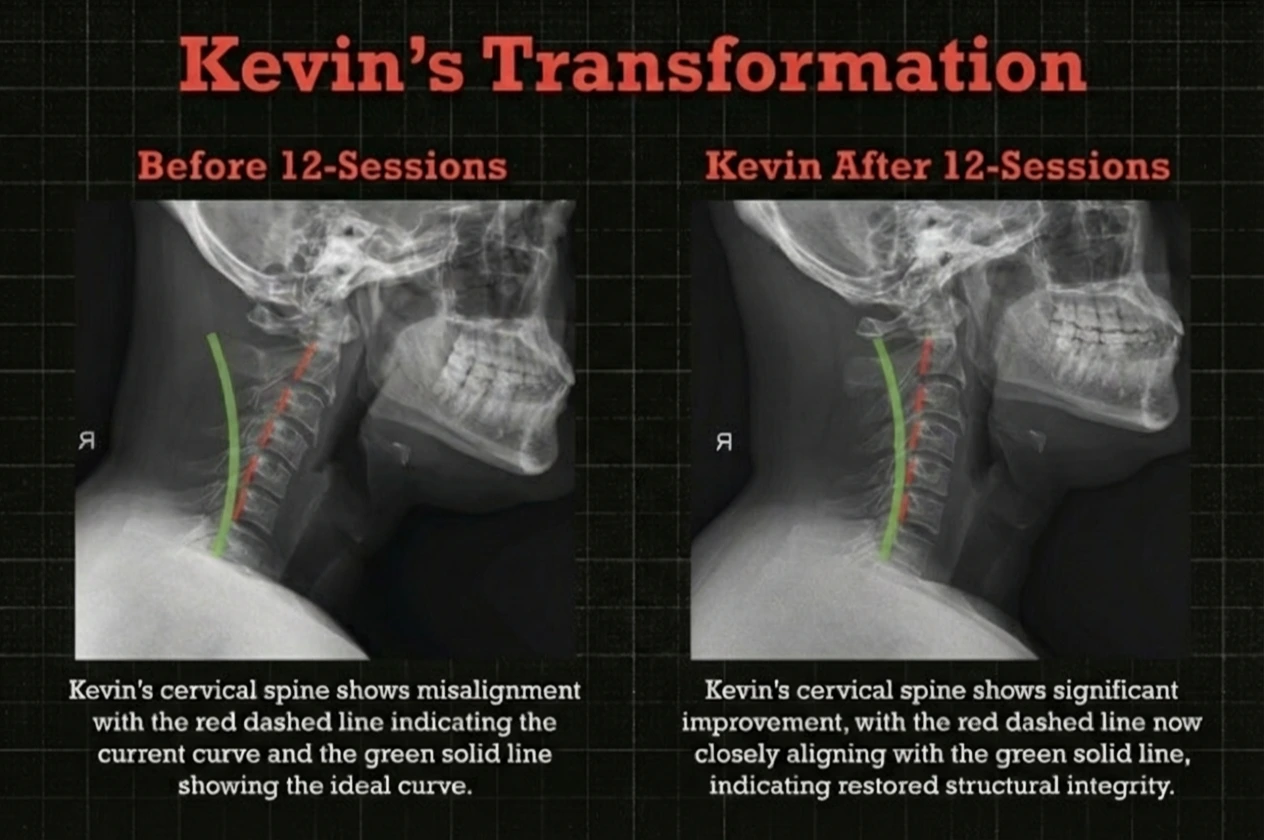

Our 90-Day "Whiplash Recovery" Guarantee
We are the only clinic in Singapore that stands by our trauma recovery with a structural guarantee: We will objectively improve your Cervical Alignment and spinal stability in 90 days, or we will refund your entire treatment fee.
We don't just promise you'll feel better, we prove the structural repair with post-correction X-ray imaging. The goal of our R3NEW X™ Program isn't just to make you feel better temporarily, but it is to physically remodel your spinal architecture back to its natural state.
T&C Applies.
Ready to stop the cycle?
1
The "Trauma Source" Analysis
Book your initial consultation, which includes a complete accident history, orthopaedic examination, and precise X-ray analysis to locate exactly where the "invisible" damage is hiding. With trauma, we’ll need some additional Flexion and Extension x-rays to assess the Range of Motion (ROM) in your cervical spine. It will show ligament instability if present.
2
The "Structural Damage" Verdict
We review your X-rays together to show you exactly how the accident shifted your spine and map out your 90-day structural restoration plan.
3
Pain-Free Living
Start your R3NEW X™ journey and experience the freedom of a light, mobile neck, so you can drive, work, and exercise without the constant fear of a flare-up.
Claim Your Whiplash Assessment & X-Ray Analysis
Conveniently serving busy professionals from Bugis, City Hall, and the CBD.
Expert Care for Whiplash & Accident Recovery in Singapore
Professional recovery for the CBD, Orchard, and Singapore’s motoring community.
Conveniently located at North Bridge Centre, our clinic is the preferred choice for accident survivors in Bugis, City Hall, and the Singapore CBD. Whether you were rear-ended on the AYE or had a "fender bender" in a Raffles Place car park, we are easily accessible for those struggling with post-accident pain.
We understand the specific demands of the Singaporean lifestyle, the stress of dealing with GIA insurance claims, the need to return to your desk at Marina Bay, and the frustration of "invisible" injuries. That is why our protocols are designed for efficiency and objective results.
Why Singapore Accident Victims Trust Us:
The Insurance-Ready Approach
We provide the objective X-ray evidence insurers need to prove structural damage.
Flexible timing
Lunchtime and evening slots designed for busy professionals.
No "Package Traps"
We focus on structural restoration so you can get back to life, not come back forever.
Efficient 90-Day Pathways
Designed for busy professionals in Bugis and the CBD, our objective, data-driven protocols optimize recovery time without requiring open-ended care plans.
Find Us in the Heart of Singapore
📍Clinic Address: 420 North Bridge Rd, #02-20 North Bridge Centre, Singapore 188727
🚇 MRT: 5-minute walk from Bugis MRT (East-West & Downtown Lines) or City Hall MRT Station
🅿️ Parking: Available at National Library of Singapore, Bugis Junction, and InterContinental Singapore
Serving Our Local Community
We are proud to be the trusted structural correction specialists for residents and professionals across the island:

Central
Orchard, River Valley, Tanglin, and Newton.

Business Hubs
Tanjong Pagar, Raffles Place, Marina Bay, and Suntec City.

Heartlands
Accessible for patients travelling from Tampines, Jurong, and Bishan seeking specialised Whiplash & Accident Recovery care not found in general GP clinics.
Clinical Research Vault: The Science Behind Whiplash Injury
Every recommendation at Dr Neck Pain Singapore is grounded in peer-reviewed research. Below are 10 published studies from Spine, PubMed, JOSPT and leading medical journals, documenting whiplash biomechanics, ligament laxity, low-speed injury forces, delayed onset, brain fog, the airbag paradox and the evidence for non-surgical structural recovery.

Clinical References & Medical Sources
10 peer-reviewed studies: S-curve mechanics, ligament damage, low-speed injury, delayed onset, brain fog & recovery
View Research

Study / Finding
The Clinical Evidence
Full Citation
The S-Curve - Why Your Neck Bends Backwards Inside a Crash
MECHANICS
In a rear impact, the lower neck snaps backwards while the upper neck simultaneously bends forward, forming an S-shape in milliseconds. You can't brace for it, you can't see it on a standard X-ray, and the maximum strain hits at C6-C7.
Cusick, J.F., et al. (2001). Kinematics of the cervical spine in rear-impact: the S-curve deformation pattern.
Spine. 👉 View Study
Spine. 👉 View Study
Ligament Laxity - The Invisible Injury
LIGAMENT
An 8G crash simulation stretched the cervical capsular ligaments by less than 1mm, too small to show on MRI, big enough to cause chronic instability and pain. The injury is real. The test was just wrong.
Ivancic, P.C., Ito, S., Tominaga, Y., Rubin, W., Coe, M.P., Ndu, A.B., Carlson, E.J., & Panjabi, M.M. (2007). Whiplash causes increased laxity of cervical capsular ligament.
Clinical Biomechanics. 👉 View Study
Clinical Biomechanics. 👉 View Study
Flexion-Extension X-Ray - Detecting Hidden Instability
IMAGING
A standard lying-down MRI won't catch post-whiplash instability. But a dynamic flexion-extension X-ray can, if the top two vertebrae shift more than 3.5mm, instability is confirmed. This is the test most whiplash patients are never given, and why so many are told they're "fine."
Panjabi, M.M. (1998). Whiplash injuries and mechanical instability of the cervical spine.
European Spine Journal. 👉 View Study
European Spine Journal. 👉 View Study
Low Speed, No Car Damage - Still 5–18G of Force
MECHANICS
At just 13 km/h - a minor parking lot bump, the human head experiences 5 to 18 G-forces of acceleration. The car absorbs virtually none of the impact because modern bumpers are engineered to elasticly rebound at low speeds. No dents, no scratches, no structural vehicle evidence. But your neck felt every single G.
Stemper, B.D., Yoganandan, N., Pintar, F.A. (2003). Kinetics of the head-neck complex in low-speed rear impact.
Biomed Sci Instrum. 👉 View Study
Biomed Sci Instrum. 👉 View Study
The 48-Hour Delay - Why You Feel Fine at the Scene
MECHANICS
Adrenaline masks your initial injury at the scene. Symptoms peak 24 to 48 hours later as internal inflammation builds. While many recover quickly, a significant percentage of victims go on to develop chronic symptoms that persist past 3 months, with some remaining severely affected long-term.
Spitzer, W.O., et al. (1995). Scientific monograph of the Quebec Task Force on Whiplash-Associated Disorders.
Spine. 👉 View Study
Spine. 👉 View Study
Brain Fog After Whiplash - It's Real, Not Anxiety
NEURO
Memory lapses, poor concentration and mental fog after a car accident are measurable neurological deficits, not stress or imagination. These cognitive problems are routinely missed in standard medical consultations.
Rebbeck, T., et al. (2019). Concussion in Combination With Whiplash-Associated Disorder May Be Missed in Primary Care.
Journal of Orthopaedic & Sports Physical Therapy. 👉 View Study
Journal of Orthopaedic & Sports Physical Therapy. 👉 View Study
The Airbag Paradox - When Safety Creates a Second Injury
MECHANICS
At low speeds (8-14km/h), an airbag deploys and blasts the torso forward while the head hasn't moved yet, creating a second whiplash force in the opposite direction. Smaller drivers and reclined passengers are most at risk.
NHTSA (2000). Advanced Airbag Research: out-of-position occupant cervical loading.
NHTSA Technical Report. 👉 View Study
NHTSA Technical Report. 👉 View Study
Myths vs Reality - It's Not in Your Head
EVIDENCE
Chronic whiplash pain is not caused by stress, personality, or litigation incentives. Structural tissue injury, stretched ligaments, irritated facet joints, disrupted proprioceptors, is the correct explanation. The "it's psychological" narrative is not supported by the evidence.
Ferrari, R. (2003). Myths of whiplash: biomechanical injury explains chronicity.
The Surgeon. 👉 View Study
The Surgeon. 👉 View Study
Non-Surgical Recovery - 70-80% at 4-12 Weeks
RECOVERY
International Grade A/B evidence confirms that spinal manipulation combined with active exercise outperforms advice alone, delivering 70-80% recovery rates within 4-12 weeks for the majority of whiplash cases.
ICON Consensus (2016). Non-surgical multimodal physiotherapy for WAD: Grade A/B evidence.
Journal of Orthopaedic & Sports Physical Therapy. 👉 View Study
Journal of Orthopaedic & Sports Physical Therapy. 👉 View Study
Singapore Clinical Consensus - Local Evidence
RECOVERY
99% of Singapore physiotherapists back multimodal PT and active exercise as the primary treatment for whiplash. The evidence-based approach is structural rehabilitation, not rest and painkillers.
Ng, T.S., Pedler, A., Vicenzino, B., & Sterling, M. (2015). Singapore physiotherapist beliefs and practices for whiplash-associated disorders.
Manual Therapy. 👉 View Study
Manual Therapy. 👉 View Study
All studies indexed on PubMed, PMC, or published in peer-reviewed journals.
Citations verified June 2026 — Dr Neck Pain Singapore, structural chiropractic clinic.